
Showing posts with label photography. Show all posts
Showing posts with label photography. Show all posts
Thursday, April 5, 2012


Wednesday, November 23, 2011
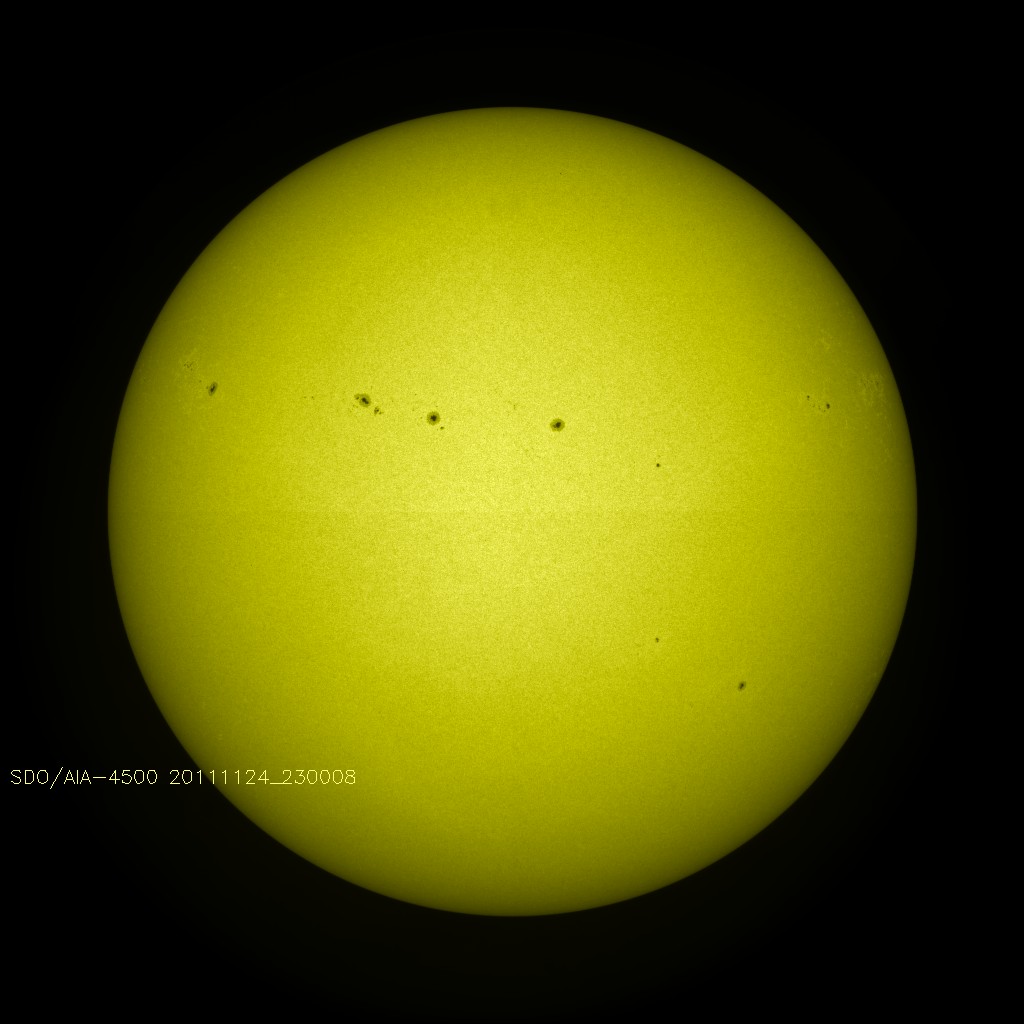
Solar projection

It's easy to point the scope at the sun--you just move the scope until the shadow of the tube is as small as possible. For safety, I make sure all the observers are on the side of the telescope away from the eyepiece.

The sunspot positions match those here.
The aperture mask was quite warm, but the eyepiece didn't seem to get hot.
Solar observing safety precautions: Do not look through the eyepiece. Do not look at the sun naked-eye, either. Stop down the aperture to prevent the eyepiece from shattering from the heat (which is a waste of an eyepiece, and might cause harm from flying shards), and push telescope away from the sun every couple of minutes to cool off. Don't use an expensive eyepiece. Never use the cheap solar filters that screw into the eyepiece. They can shatter while you're viewing and the sunlight is then likely to blind you (and I had one as a kid that faded with time--it got less and less dark! fortunately, I never used it in the telescope).
Tuesday, October 25, 2011
Sunday, August 28, 2011
Micrometeorite candidates

Here is a particularly pretty area. The pointer is pointing to a round micrometeorite candidate. It's stuck to some probably earth-origin stuff--the hard drive magnet magnetized all the samples, so they stick together. There is also a pretty piece of glass or crystal closer to the top edge.

I ended up perfecting a method for extracting them. First, I use the toothpick to sweep the area around it clean, looking in the microscope most of the time. It's confusing, since the miscroscope reverses the view, but eventually the brain gets used to it. Then I wet the toothpick with acetone. The micrometeorite candidate sticks to the toothpick. I then transfer it to a clean piece of glass. Because the acetone evaporates so quickly, it's easy to just wipe the toothpick on the glass and the micrometeorite drops off. I lost two promising samples--especially that nice big round one in the first photo--before I got the above two.

If you try to view this with bright-field microscopy, of course you just get black silhouettes. What I did is I taped a bright LED flashlight to the microscope, pointing at the sample, and then I took timed exposures, holding the camera to the eyepiece (sometimes with some sort of adapter to keep the camera in place). For the second two photos, I found a way of adding more light. I took the microscope outdoors, and then reflected sunlight onto the slide with a mirror (actually, a hard drive platter--they make lovely mirrors).
The photos were taken with point and shoot cameras hand-held to microscope eyepieces, with some loose-fitting adapters to make it easier. The first photo was with a Sony P100 through the 10X Huygens eyepiece that the microscope came with. The second and third photos were with a Canon G7 through a Rini 30mm telescope eyepiece, using my home-made telescope-to-microscope eyepiece adapter.
Update: I wish I knew how to better identify micrometeorites. The very round one may not be one--see this article.
Wednesday, November 17, 2010
Clavius

Subscribe to:
Posts (Atom)